
My Compound in The Redwoods
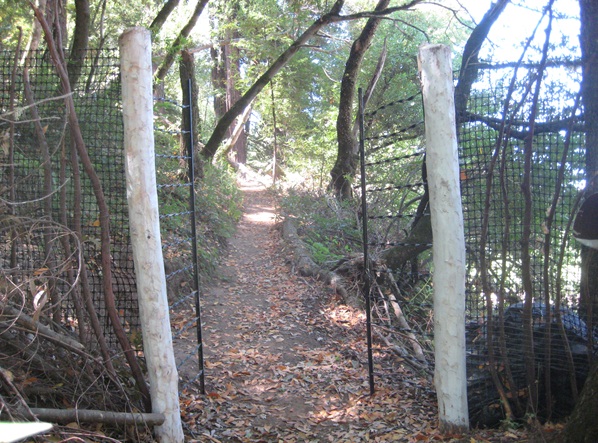
The entrance to my property. You can just make out the redwood trees up the trail, some of the first groves on Redwood Road.
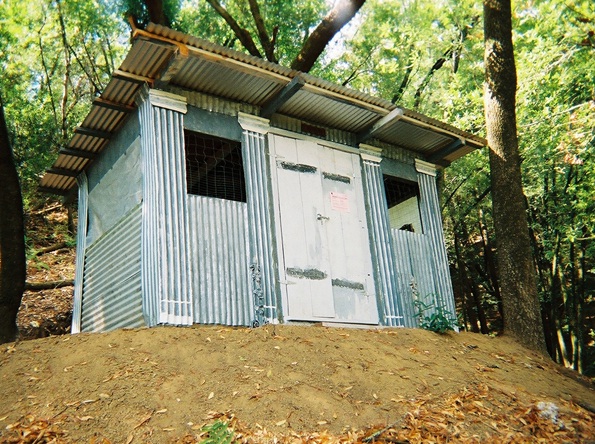

This is the Library, containing almost a thousand volumes on the growth of California and the West. It's about a hundred feet up the winding trail from its start on Redwood Road. Note the yellow clay; you find it just a foot or two under the forest floor in the Mayacamas Range, and below that you hit water-storing sandstone. The dimensions are 8x14 feet, making for a square-footage just under the County's 120-square-foot-limit for buildings that don't need permits.
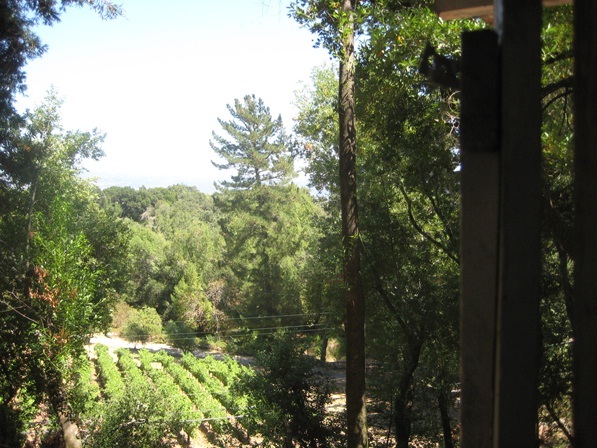

The view from The Library. Just over those ridges is Alston Park, where they have the dog runs. If it weren't for the morning haze, you would see the Vaca Mountains on the far side of the Valley. Silverado Country Club is behind that pine tree. To the left of the opening you would see the old Soda Springs Resort.
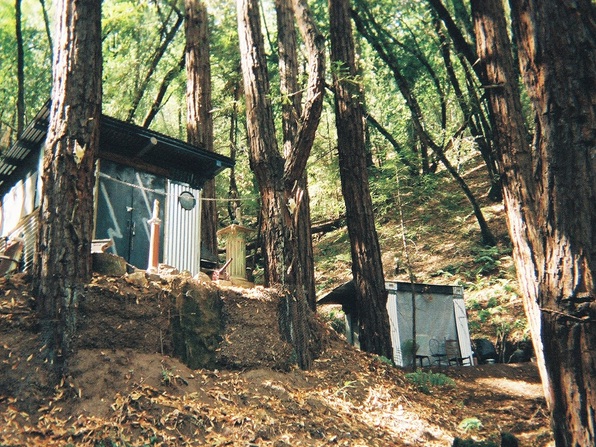

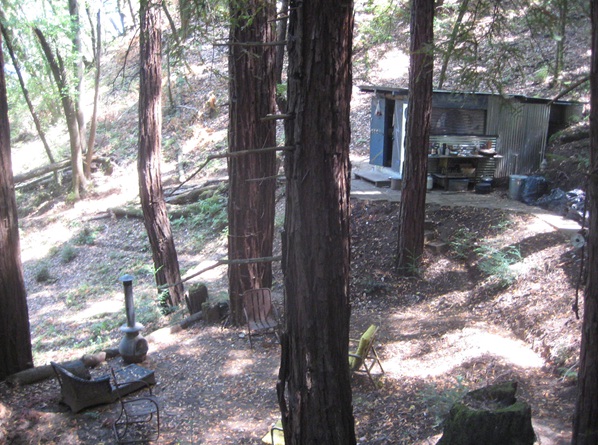
On the left is The Tea Room, on the right The Bathhouse; each is roughly eight-feet square. I cut the terraces they sit on where a couple of creases separating a ridge spur converge on the main gulley. There was hardly a flat spot anywhere on the property when I took it over, and you couldn't see 20 feet in any direction without a tangle of trees obscuring visibility. These are a couple of hundred feet up the trail from The Library.
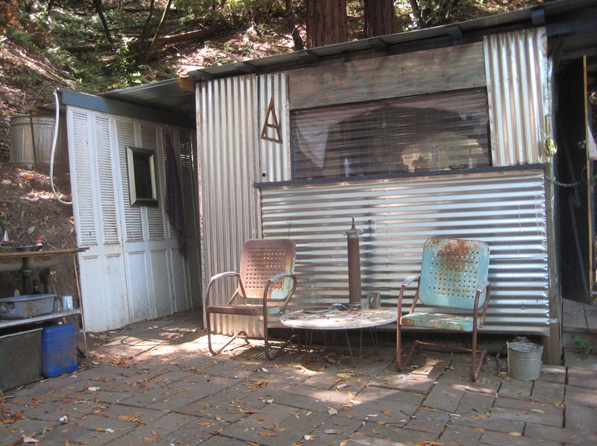

A close-up of the Tea Room. Concrete paving blocks cover the terrace, providing a stable surface that allows water to drain through and beneath without undermining it. This building's roof extends to the hillside, its shallow pitch catching rain water and draining it into a three-hundred gallon galvanized metal water trough at the upper left. Gravity flow and a hose provide running water to the sink just visible on the bottom left side of the picture.
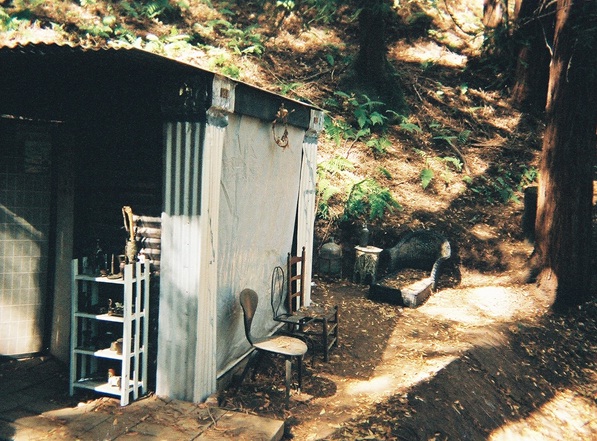

I built The Bathhouse in a day, with scraps and leftovers. It consists of four posts set in the ground, forming an eight-foot square, attached on top by 2x8s nailed on the vertical plane. There's another joist running down the center inside to support the corrugated steel roof. Unlike the raised plank floors of the other structures, this building's floor is comprised of the concrete paving slabs.
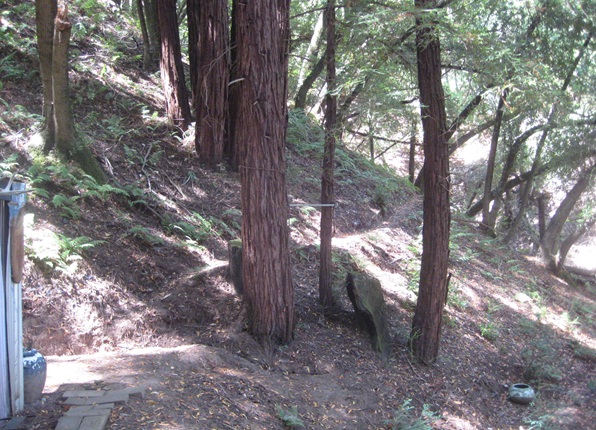

One of the many trails coursing through my property. This one winds around the spur and goes left, up to the ridge top, where the Mayacamas Mountains tumble into the Carneros hills. My land spans several little microclimates. At the bottom, where there's filtered sunlight, there's blackberry, hazel and oaks. In the forest darkness, it's predominately redwoods and bay trees, with ferns; further up a bit the madrone starts. At the top, the oaks return.
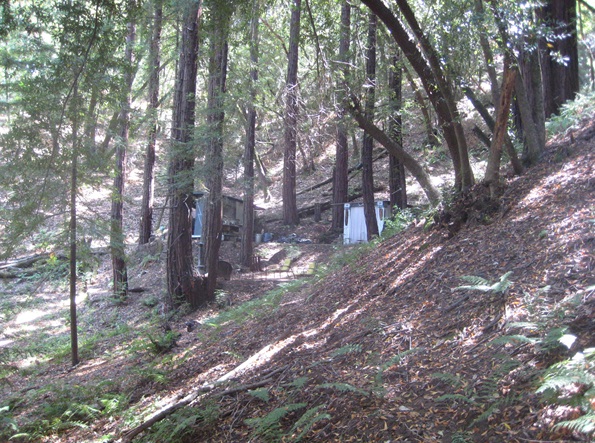

The view from the trail of The Bathhouse and The Tearoom. They're situated at the top of the central gulley, falling away to the left. I chose the location because of the redwoods, which help prevent the bay trees from falling on the structures. Note the darkness of the forest; before I started removing the snags and deadfalls, the sun never penetrated the canopy.

A terrace constructed on the remains of a big tree that fell, just missing the buildings. After chopping the 80-foot trunk into manageable logs, I rolled them into place before filling them over with dirt and clay. Note the trail in the background, on the south side of the gulley. After cutting it to conform to the slope of the hillside, I pounded sandstone into it, creating a tough, natural gravel surface.


Living Off Grid

Notes on living in the wilderness, for the simple
pleasure of it...or to survive The Apocalypse


I may not be the Greenest Man in America, but I must be close.

My annual resource consumption consists of twenty gallons of propane, a thousand gallons of water, forty AA batteries and a hundred candles. Or less. I ride a recycled bicycle for transportation. I consume about 2500 calories per day, and my bodyfat hovers around ten percent. I eat just enough food to stay comfortably alive.

Not only do I contribute little to the detritus of human civilization, I actively counteract the effects of several households who may add to it. I maintain five acres of atmosphere-cleansing forest, actively managing it to promote new life and growth, whether for the plants or animals.

That means I cut lots of trees, but with an axe, rather than chainsaw. And move lots of dirt, with pick and shovel. I'm shaping not only the forest, but the earth beneath it. I contour the mountainside with trails and terraces, I send the water where I want it to flow. And by clearing the dead and dying trees, I admit light to the forest floor and let the little plants grow. The brush berms created provide homes to smaller birds, the untangled canopy provides free air space for the bigger ones to fly. The animals walk my trails to browse on the new greenery brought forth.

My ultimate goal is to create a natural garden in the forest, to demonstrate how man can improve on nature and make it better; more attractive to look at for people, easier to use for man and beast. And healthier for the forest itself.

So these are my circumstances, this is the land I am transforming, with the additional features of my own small library and museum collection. Perhaps my observations will speed your own learning curve should you choose a similar course. Or, just as likely, help you decide to avoid it.


In The Beginning

One day when I was a child, my parents drove from San Francisco to Napa and bought some land on Redwood Road; eventually, we accumulated 40 acres. At first, they built a country retreat, where for years we spent weekends and hosted sizable parties with dozens of guests staying over.

Eventually, we built a house where the cabin had been, and I spent my adolescent years there. After my parents divorced, my mother was gone frequently, and I had the place more or less to myself. I reveled in the land, my own little world; I long fantasized about really owning some of it for myself, and doing exactly what I wanted with it.

Well, it took forty years, and due to a range of circumstances, I ended up with my own five-acre parcel in the redwoods, a mile south of where I half grew up. I couldn't have asked for more; it was just what I'd always desired.

During the intervening decades, it just so happened that I lived a rather unconventional life, with lots of travel, and resort hotels of every variety. But I also spent what amounted to years living in barracks, huts in the mountains, work camps in the jungle, military camps in some wilderness. Not only did I become comfortable living without conveniences often taken for granted, I came to relish the experience. Despite a mostly upper-middle class lifestyle, I had become feral in many respects.

Then I got that five-acre parcel, and I could indulge all my childhood fantasies of a pioneer beyond civilization. Even though I'm a mere five miles from downtown Napa.


The Land

The land has about 325 feet of road frontage, and it goes 700 feet up the ridgeside, a rectangle comprised of two squares. A dirt road runs across the top of the property. Situated on Redwood Road where Redwood Canyon begins, the land has some of the first redwood groves on the country lane; on the other side of the road, Redwood Creek meanders toward the Napa River.

Because of this unique location where my mountainside, the road and the creek diverge at the opening to Redwood Canyon, animals find it convenient to pass through my land between the forests on my side, and the hills, water and vineyards on the other. Just beyond the top end of the parcel, you can see the Carneros region and upper bay to the south; looking north displays the beginning of the Mayacamas Range that reaches up to Calistoga and Santa Rosa.

My place is a choke point for all the animals of the back country which come down for water in the summer. I've seen mountain lion and bear, red fox and grey, bobcat and lynx, and, of course, deer, skunks, possums, squirrels. And an amazing array of rats, mice, gophers and moles. Coyotes are ubiquitous, but more often heard than seen.

And there are birds. Oregon Juncoes have made my Tearoom terrace a trysting spot, and hawks nest in the redwoods. Pileated woodpeckers fly through in late winter, and quail lurk always. The owls tend to visit in the fall.

I not only live in nature, I've become part of the natural ecology, changing it dramatically sometimes. But on behalf of my forest neighbors--and my own safety--I must do what I must do thoughtfully, with a respect for nature. Otherwise it will kill me.


Why bother?

For centuries, people of wealth have appreciated the pleasures of a country life, and even people of more modest means have felt the impulse over the last generations. It's a fine, simple luxury, whether camping rough or in a campground, whether visiting a rural cabin or a country estate. I've encountered them all, here and abroad, and passing time in the presence of nature, absent the demands of a busy, urban life, is its own reward. Self-evidently.

Not lost on many of the proprietors, especially those abroad, is how convenient such places can be in times of anarchy, civil discord or social breakdown. Even without vast armies raping and pillaging the land and people, life can turn grim fast without gas, electricity and all the infrastructure they supply with energy. Great cities and exurbs will suffer most if power and supply systems break down, and if nothing else, a place in the country puts you closer to where food is grown and basic survival skills are still practiced: hunting, raising livestock, planting crops, making things. Making do without stores and help down the street.

It also removes you from desperate, hungry, scared mobs in populated areas, not to mention their passions.

Learning how to live off-grid, and having a place to practice it at your pleasure, might just save your life. Besides enhancing it.


My Philosophical Approach

Living the Green Life has become something of a fad, along with living closer to nature and off-grid. At least in the abstract. But whenever I see accounts of people or designers doing this, I note that it's all so expensive and complicated as to be irrelevant to most people, including those who can afford such places. Complicated systems of any sort are more delicate than simple ones, and they need maintenance and parts over time, whether a generator or a solar panel array. Passive heating and cooling systems, I'm sure, have their own ecentricities.

I don't mean to suggest these things are wasted folly or not worth having; just that they're often expensive and unreliable over time, especially in desperate times. So, I offer a cheap, simple approach, based on my own, specific, practical experience. Take it as you will. But don't expect to keep on living a life filled with modern conveniences, if things go way bad, no matter how complete your own infrastructure.

Simple is simply better, and it promotes your own self-reliance, which is all you can ultimately count on.

On the flip side, I'm no big fan of extreme survivalism and mastering primitive skills, like making fire by rubbing sticks, a shelter of limbs and leaves, or neat little snares for rabbits. Nice things to know, of course, but if you're forced to depend on those skills, you're already on your way to extinction. Those things help for a week or so, trying to escape from somewhere bad, or surviving a stranding in the wilderness.

Those skills take time to master, and will be useless in most circumstances. But you can learn easy and simple approaches pretty fast, and develop an aggressive learning curve with lots of payoff for the effort.


Get to Know Your Land

My few projects have been here in the California Coastal Range, and I've built five cabins and a house. I also flipped several other houses, despite being a white-collar kind of guy not inclined to accumulating power tools and reasons to use them. But I grew up used to physical labor, learned how to pick and shovel and cut trees down in the woods, and I spent a fair amount of time in the Third World, seeing how things were done without our devices.

Additionally, I observed people living in the most rain-sodden mountains you ever saw, without washing away. They studied and knew their terrains, and built accordingly. And even though you hear of villages being wiped away by mudslides from time to time, most aren't. Where people have lived and built for centuries, they generally know what to expect.

My own five-acre property sits on a ridgeside in a temperate rain forest with incessant rain some years during the winter; there are six dry months--mid-April to mid-October--and six rainy. Every five or ten years, it might be especially wet, with major flooding somewhere in the valley. Given that my place is riven with ridges, declivities and seasonal water runs, picking a spot to build demanded close attention to water avoidance.

But it wasn't as bad as it looked, and though people predicted my structures would wash away since they seemed to be surrounded by water runs, the threat was mostly illusory.

I have several creases running into the main gulley, which dominates the lower half of the parcel; on its north side, there's a water run six feet deep by six wide. A few hundred feet long, it drains a couple of acres at most. This I could see in the looking. But I noticed more; the naturally formed ditch had cut into the clays, but elsewhere, despite evidence of regular seasonal water flow, there was little erosion. The deep ditch was the product not of great masses of water every year, but rather little trickles over hundreds of years.

A further hint were the deadfall trees, that were moved not at all by the water. More to the point, many had rotted to the most delicate state. When dry, old branches and twigs would fall to dust with a touch; wet, they'd sag and drop. I found this characteristic throughout the water runs, one that would not exist with substantial water flows. The rotten stuff would have washed away.

Since it didn't, I knew I had manageable water flows, easily diverted by trails or trenches.


More to come...


~ ~ ~


All Contents Copyright WineMerchant.com 2012