TWHP
Virginia City, & Environs
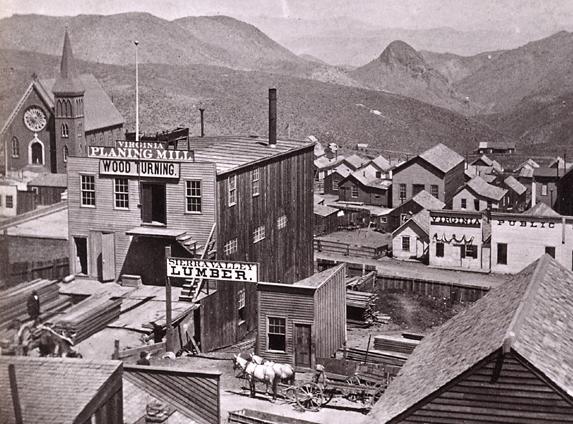
Virginia City, Nevada, exploded into existence in the spring of 1860 after silver was discovered there the previous year. Every failed gold miner in California headed for the Nevada mountains just over the Sierras, and the town quickly made the transition from tents to wooden buildings to brick. Sitting atop the greatest concentation of silver on earth--the Comstock Lode--Virginia City soon concentrated the men and materiel to exploit it. When the difficulties of extracting the metal from deep underground inhibited work in the early 1860s, the new Bank of California opened a branch in 1864, loaned money liberally, foreclosed as fast as possible, and built an empire in San Francisco based on the wealth it soon learned to remove from stubborn rock. The bank's manager William Sharon financed processing mills, a railroad to the Carson Valley and all the services needed to maintain a large working population and a city to house it.
By the 1870s, it was the largest city between San Francisco and the Mississippi, boasting the six-story International Hotel, Piper's Opera House and a population of 22,000 at its height. The mining never stopped and the town never slept, the main thoroghfare of C Street thronged day and night by off-shift miners. The downslope side of C Street hosted the downmarket saloons, and beyond clustered housing for the workers and a lane lined with prostitute's abodes,
The opposite side and hills above catered to the managers and eventual millionaires. Displays of wealth and luxury contrasted with parched, rocky desolation, the restaurants and clubs serving some of the finest food and champagne in the world while men toiled thousands of feet below the surface. Impressive mansions rose on the mountainside, appointed with the acme of interior design. A wonder of the world for the best part of two decades, magnates and celebrities regularly visited the town to see its diverse wonders. After a fire devastated it in 1875, Virginia City was rebuilt to even greater splendor. It would last forever.
The silver played out in the 1880s, however, and the town suffered a long decline, the odd fire and profound isolation all but killing it off. The Bank of California finally closed its branch a decade or so into the new century, giving up the ghost long after the corpse was cold.
~ ~ ~