TWHP
Stockton, The Commercial District
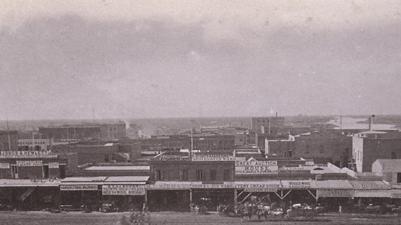
Stockton was founded in 1849 by Charles Weber, a German immigrant who'd acquired a Mexican land grant of 49,000 acres after coming to California in 1841 with one of the earliest wagon trains. Giving gold mining a try in 1848, he concluded there was more money to be made supplying the camps. He established a community on the edge of a slough connected to the San Joaquin River, and his port town quickly grew as a conduit to the gold fields in the more southerly Sierra foothills not accessible from Sacramento.
But vast marshes and soggy lowlands limited access from the coast, restricting transportation to the river for the most part, and the gold diggings weren't as numerous as those in the northern reaches of the Mother Lode. Named after Commodore Robert Stockton, a hero in the Mexican War, the town could never play the role in the gold and silver exploitation provided by San Francisco and Sacramento. Instead, Stockton evolved into a major agricultural center, and in 1869 the Western Pacific Railroad linked it to San Jose in the west with Sacramento to the north, enhancing its role as a regional transportation hub. Additionally, its situation on a deep waterway allowed it to become a uniquely large, inland port, able to accommodate ships transporting its produce across the oceans rather than having to depend on railroads.
Over the decades of the 1860s, '70s and '80s, California grain fed the world, its Central Valley from Red Bluff to Fresno covered by sprawling wheat farms of tens of thousands of acres, each employing men and draft horses by the hundreds. Stockton accounted for much of the trade and prospered accordingly, grand Victorians in the middle of large ranches proliferating in the satellite communities, owners living like feudal lords. But overproduction on the same lands year after year depleted the soils, and crop yields declined just as Argentina and Australia entered the world grain markets, flooding them to California's detriment.
The big spreads were broken up and sold off as the wheat gave way to other crops, and the smaller farmer gradually took over, Stockton and its dependents adjusting to the reduced circumstances.
~ ~ ~