TWHP
Sonoma, Town Square
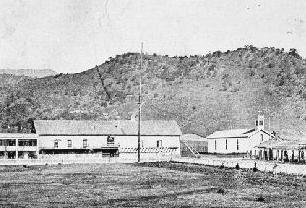
Sonoma started life as a mission, founded by Father Jose Altimira in 1823, but the local Indians soon burned the buildings, and the priest departed.
A successor rebuilt it by 1832, and in 1836 General Mariano Vallejo took over the settlement to secularize the community and turn it into a town. He constructed a barracks and home for himself, turning it into an outpost designed primarily to discourage the Russians on the coast at Fort Ross from incursions south. The largest settlement north of Monterey at the time, Sonoma served as the central point from which Vallejo also subdued the Indian tribes for a radius of 50 or so miles.
As tensions mounted between the United States and Mexico, American settlers seized Sonoma and imprisoned the General in 1846 during what would become known as the Bear Flag Rebellion, and the independent Republic of California resulted. Within a month, the perpetrators were superseded by the American military, which acceded to control of the newly conquered territory. Over the next several years, Sonoma hosted many of the great figures of American history as a major administrative center. Civil War generals Grant, Sherman and Hooker passed through, as did John Fremont and Kit Carson.
Otherwise, the activity was decidedly agrarian. The mission priests had already started growing grapes there, and Vallejo cultivated proper vineyards and made wine before the American occupation. But with the arrival of Agostin Haraszthy, an adventurous Hungarian looking for the ideal terrain for growing grapes, Sonoma briefly shot into the vanguard of winemaking. Moving there in 1857, he commenced work on a stone cellar and planted 40,000 vines the next year. Over the next several years he built his landholdings to a total of about 5,000 acres east of the town, and his Buena Vista Winery was thought to be the largest winemaking operation in the world. By the late 1860s, he was bankrupt.
Meanwhile, the town steadily lost stature after the American occupation, as business moved away in the fevered environment heralded by the Gold Rush. Confusion over land titles derived from the Mexican land grants and incursions by squatters kept the area tangled in litigation for decades, severely restricting growth; farmers bought land with clear titles elsewhere, and business followed.
By the 1870s and '80s, many of these problems dissipated, and the wine industry grew along with other agriculture; but the phylloxera vine blight killed former, and the latter struggled as well. When railroads started laying tracks north from the Bay, surrounding communities thrived, leaving Sonoma
behind, an afterthought. Little resorts did spring up in the area, but they were modest affairs, adding to a feeble economy that would know little real prosperity for decades.
~ ~ ~