TWHP
Napa, The Courthouse
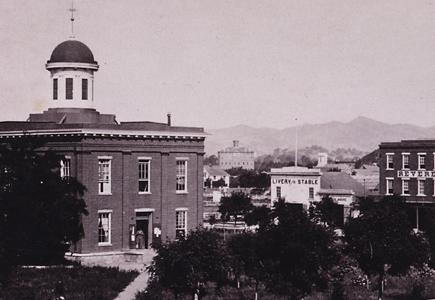
Even though Don Cayetano Juarez first moved to near the site of the town in 1841 after receiving a Mexican land grant of some 8,000 acres--Rancho Tulocay--Nathan Coombs takes credit for founding Napa City in 1848. Situated at the confluence of Napa River and Napa Creek, it provided a convenient ford on the route between Benicia and Sonoma, the most important towns north of the Bay in those days. Probably named after the Wappo Indians' word for "hut" or "village," it seems likely that early settlers confused the words for where the people lived with the people themselves.
Despite suffering brief population loss as the Gold Rush drew men away, the town eventually benefitted from the frenzy since it became a popular route to the diggings of Trinity County. Many returned to the lovely valley extending 30 miles north of the town to settle, and as the head of navigation on the river, Napa grew as a regional commercial center. Kit Carson allegedly laid the cornerstone for Napa's first masonry building in the mid-1850s; by that time, Main Street was well-established, every other business allegedly a saloon.
By 1868, Sam Brannan had constructed a railroad through the valley, a line from Vallejo coursing through the town and up to Calistoga, site of the promoter's hot springs resort; vacationing had already become an attraction, hostelries proliferating. Soda Springs, situated on a mountainside northeast of Napa, would become the most famous, its waters ultimately sold nationwide.
John Patchett planted the first vineyard near the town during the 1850s, but grain came to predominate in the valley proper, accounting for about half of its 60,000 acres under cultivation by 1880, orchards and vineyards making up the difference.
The wealthy of the San Francisco discovered the region, and as would happen a century later, they constructed large homes and then wineries of fine architecture. The local wines earned a good reputation, and the wine and brandy industry began to flourish, displacing the wheat. Smaller growers suffered at the hands of San Francisco wine merchants, however, and bankruptcy forever threatened. With the coming of the phylloxera vine blight and high federal taxes on brandy in the 1880s and '90s, the threat became reality, crippling the wine industry. Recovering after the turn of the century, the Federal Government crushed the industry again with Prohibition in 1919.
A state insane asylum built in 1875 helped the town limp along, but it wasn't until well after the Second World War that the town began to experience anything like widespread propserity.
~ ~ ~