TWHP
Folsom, Bridges & Town
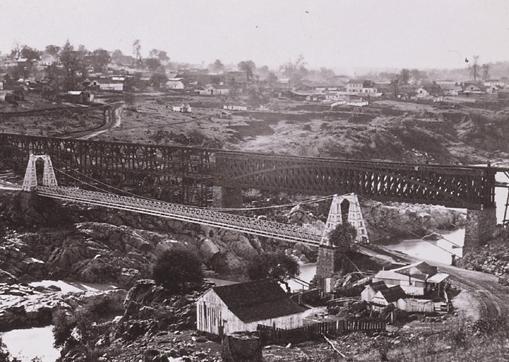
The destination of California's first railroad, Folsom started out in the late 1840s as an adobe house built by William Leidesdorff. The San Francisco merchant had acquired a Mexican land grant on the American River, but before he could inhabit his house, he died in 1848, just as word of the gold discoveries leaked to San Francisco. Joseph Folsom bought the property--by then known as Negro Bar as a result of blacks working the diggings--hoping to reap real estate profits as land prices skyrocketed with the Gold Rush. It seemed to be his by 1852--title was clouded by litigation--and he hired Theodore Judah to lay out a town. A railroad builder by training, Judah soon conceived the idea of a railroad to Sacramento, some 22 miles away; Folsom headed the Sacramento Valley Railroad.
Granite City, so-called, had become the gateway to the diggings up and down the American River, and a railroad and town at the site offered great commercial potential as a supply center for the miners. But it took Judah--eventual promoter and surveyor of the Transcontinental
Railroad--four years to get the line built. Folsom died in mid-1855, just six months before the train's debut in 1856; it was California's first railroad. Within the month, more than two thousand Granite City lots sold out. The new town adopted Folsom's name.
Folsom funnelled traffic between Sacramento and the Sierra foothill towns of the Mother Lode, and in 1860, the Pony Express made it a western terminus since dispatches could be sent on by train. In 1870, the idea for a dam along the American River took root so hydroelectricity could be produced for Sacramento, and to build it, cheap labor was provided in the form of inhabitants for a new prison. Constructed of the local granite quarried by convicts, Folsom Prison opened in 1880, and Folsom Dam was completed in 1893. The lights finally went on in Sacramento in 1895, 25 years after the dam was imagined.
~ ~ ~