TWHP
Leland Stanford, 1824-1893
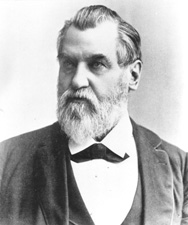
The most memorable member of that railroad-building team known as the Big Four, Leland Stanford played brilliantly the role of respectable mouthpiece and politico. He achieved early success as a politician with his election as governor in 1861, a position he gained in large part due to his inarticulateness in an age of golden-voiced oratory. Stanford was said to have taken up to a minute or two in answering such questions as "How are you?", and only after laboriously considering the query. Since politicians were thought to be corrupt beyond imagination--true enough in early California--and their speaking ability a trademark, Stanford's painfully mumbled speeches struck listeners as the wise musings of a sincere and honest man. A native of New York, he studied and practiced law--he passed the bar in 1848--until deciding to join his brothers in California in 1852. After several years of success, he bought them out of their Sacramento store and began to dabble in politics, helping to establish the new Republican Party in the state. He was elected governor in 1861 only because the Democratic vote was split, and he insured that California would stay in the Union in the face of Civil War. At the same time, he used all the clout of his position to promote the railroad and encourage government subsidies; he became president of the Central Pacific in 1863 on departure from office. After the Transcontinental Railroad was completed in 1869--it was Stanford who drove in the golden spike--Collis Huntington would complain that his partners became distracted by other ventures while he had to continue building a railroad empire, and Stanford was the most venturesome of the bunch. He created great racing stables on his property south of San Francisco at Palo Alto, and he built a huge winery and vineyard operation at the north end of the Sacramento Valley at Vina in Tehama County. Ironically, the latter failed dramatically because the land wasn't suited to producing great grapes; meanwhile, he picked up most of Calistoga after Sam Brannan's failure, and he ignored the possibilites in an area now renowned for its vineyard quality. Stanford became a United States senator in 1885, a year after his only child, Leland Junior, died of cholera in Florence, Italy, at the age of 15. While he did little in the Senate, he and wife Jane did found Stanford University in 1891--on the grounds of his horse ranch at Palo Alto--named in memory of their departed son.
~ ~ ~