TWHP
Junipero Serra, 1713-1804
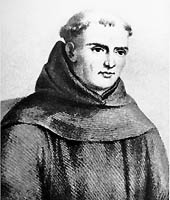
Born on the Spanish island of Majorca, Junipero Serra became a Franciscan priest and combined all the attributes of a religious scholar with those of a humble, pious aescetic. After becoming a teacher of theology and philosophy at a Spanish university, he requested a transfer to Mexico in the late 1740s, trading comfort and prestige for the opportunity to save native souls. It would be 20 years more before he began the trek into Upper California, and in the interim, the conditions that made it possible came to fruition. Until the 1760s, the Jesuits supervised most of the Spanish Catholic Church's missions in the world, but they were thought to have become too powerful and their agendas often conflicted with those of the civil authorities. The Spanish Government
decided to turn the task of converting the indians over to the Franciscans, a religious order lacking the intellectual arrogance of the Jesuits. The latter had already established 18 missions in Baja California, and in 1769 Serra headed into Upper California with Gaspar de Portola, the military commander who would build army posts while the priest would establish missions. The first of the nine Serra constructed was at San Diego, and his successors would eventually raise 12 more; ultimately, you could walk the length of Spanish Upper California--San Diego to Sonoma--and find each mission a day apart from the next. Serra worked tirelessly on behalf of his indian charges, and did what he could to protect them from abuse at the hands of settlers and civil authorities, at the same time trying to prepare them for the changing world that was coming. Though often criticized for destroying the indian culture whose members' souls he hoped to save, Serra acted out of sincere convictions and sacrificed much as a result. Those cultures were doomed no matter what, and any fair accounting suggests that their members at least suffered a little less as a result of men like Serra.
~ ~ ~