TWHP
John Mackay, 1831-1902
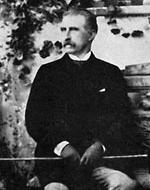
Considering the great fortune he accumulated and the big things he did with it, it's surprising to note how little known is John Mackay. His name seems all but forgotten in San Francisco, the city his riches helped build, and memory of him remains slight elsewhere, despite the fact that his name fascinated the world for a generation. After apprenticing as a carpenter, building ships in New York and boarding one of them for San Francisco, he headed to the gold fields and found nothing much. When silver showed up in western Nevada, Mackay headed for the Virginia City mines and went to work as a carpenter. He soon became a contractor and an expert on building the squaresets that supported the great caverns underground, and his familiarity with the different operations put him in good stead to gather useful intelligence. He became friends with future partner James Fair, and through him, met his eventual wife, Marie. Mackay started investing successfully in mine ownership, and with Fair decided to try to take over the most promising properties. But their plans were incomplete until they united with James Flood and William O'Brien in San Francisco, two men who'd turned success at saloon ownership into a valuable information-gathering enterprise. With what they learned from bibulous customers turned into profitable investing, and they became stock brokers. The four took over the mines that tapped into the biggest silver veins, and within a few months during 1872 and '73, they became famous as owners of the Big Bonanza, and later, as the Bonanza Kings. By the time the silver played out toward the 1880s, Mackay's name was universally famous, largely as a result of his free-spending wife, Marie, who'd moved to Paris and dazzled the world with her lavish spending. Mackay started the Nevada Bank with Flood and Fair to challenge the Bank of California, and he subsequently laid a trans-Atlantic telegraph cable to challenge the monopoly held by Western Union. He would eventually create his own continental network, and he died soon after he laid a trans-Pacific cable between San Francisco and Manila. Mackay had a temper, but he was generally considered to be a kind, patient, open-handed man. It was said that young men by the hundreds wept at hearing of his death, having been beneficiaries of his generosity as boys in Virginia City. He donated lavishly to many charities, and inevitably demanded anonymity. Despite leaving school at a young age, he never stopped trying to improve himself, and read broadly; he especially loved the theater. He spent as little time as possible with his wife and her pretentious European friends, and one of his great disappointments was the loss of pleasure in playing cards; he was so wealthy that winning came to mean nothing to him. He was among the world's first, famous self-made men, and the wealthy of a succeeding generation used him as their model.
~ ~ ~