TWHP
Agoston Haraszthy, 1812-1869
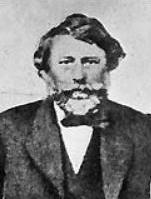
Few early founders of California can boast of more accomplishments of greater variety than Agoston Haraszthy. Considered to be the man most responsible for California wine-making, and, by extension, the American wine industry, Haraszthy's reputation in that realm has waxed and waned through various historical revisions. It is beyond dispute, however, that he played a large role in its development. Born in what is now Budapest, Hungary, Haraszthy took his family to Wisconsin in 1843 and founded Sauk City, probably planting the first hops and vines there; he also may have run the first steamboat up the Missouri River. He may have moved his family to California to avoid debts, and he establishes here the pattern that is to haunt him for the rest of his life. A clearly capable man of great energy and popularity, Haraszthy habitually took on more than he could handle, and just as habitually found himself enmeshed in controversy and financial difficulties. From Sauk City, Haraszthy emigrated to San Diego, where he was elected the first sheriff of the American era, and, again, planted grapes. Just as in Wisconsin, though, they didn't do well. He also built the county jail, helped quell Indian uprisings, and got himself elected to the state assembly, where he met General Mariano Vallejo, who convinced him that Northern California was well-suited for vineyards; by the late 1850s, Haraszthy had established himself in Sonoma. He started what would become one of the biggest vineyards in America, and then embarked on a government sanctioned trip to Europe to study winemaking, eventually bringing back a hundred thousand vines to distribute throughout California. In the early 1860s, Haraszthy formed a corporation to take over his Buena Vista winery operation, which ultimately included what would become the famous Carneros region. Within a few years, though, his vineyards were in ruins, probably due to the phylloxera blight that would ravage vines worldwide, and he lost his properties. After declaring bankruptcy, Haraszthy traveled to Nicaragua and convinced the government to grant him a monopoly to produce rum; just as his luck began to improve, Haraszthy disappeared into a river, perhaps while trying to cross over a log that broke underneath him. He was either drowned or consumed by an alligator, the latter a credible belief because his body was never found. It was a flamboyant end for a remarkable man, who was neither as great as his promoters contended, nor as negligent as detractors claimed. He was, rather, a perfect example of the kind of dynamic adventurer that abounded in California at the time, dazzled by the many opportunities, but unable to avoid grandiose schemes.
~ ~ ~