TWHP
Ambrose Bierce, 1842-1914
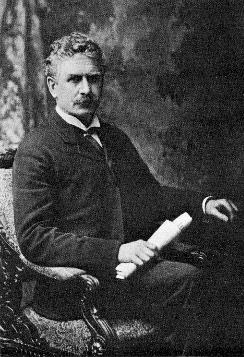
One of the great cynics of his age, Ambrose Bierce distinguished himself as a caustic writer, crusading gadfly and a particularly cruel man. His journalistic career got the hint of a start before the Civil War, when he was a printer's helper for an abolitionist newspaper in Indiana. He became a mapmaker during the war, and found himself on the scene of several great battles before he was wounded at Kennesaw Mountain in Georgia. He made his way to San Francisco in 1867 and went to work at the mint before establishing himself as a newspaperman a year or two later. His experiences in the war and working for the Treasury Department encouraged his satirical nature, and his bitterly nasty pen spared no one under any circumstances. When a fellow journalist's son passed away, Bierce used the opportunity to castigate the man; when Bierce's own son was killed in a duel, the San Francisco press corps avenged the depradation with an avalanche of nastiness. Despite a couple of marriages he carried on an odd relationship with novelist Gertrude Atherton, and she unwittingly damned him with the faintest of praise when she once wrote that his work was as good as the best that writers were doing 20 years earlier. His most well-known effort was The Devil's Dictionary, a book that sought to show the real nature of things through offbeat definitions. For instance, take the word corporation:
"An ingenious device for obtaining individual profit without individual responsibility." The railroad interests aroused his anger more than any other topic, and he ceaselessly attacked the Southern Pacific Railroad and its many monopolies. After alienating everyone it was possible to alienate, he went to Mexico in 1914 to watch the revolution and meet Pancho Villa. He was never heard from again.
~ ~ ~